Is Nike Getting Its Cool Back?
The latest data shows a massive shift in sentiment and demand from consumers for Nike. Are we finally calling a turnaround?

Megan Brantley
February 04, 2026

Last Friday, people lined up outside a Costco in Brooklyn before sunrise. Not for a pallet of paper towels. Not for a rotisserie chicken. For sneakers.
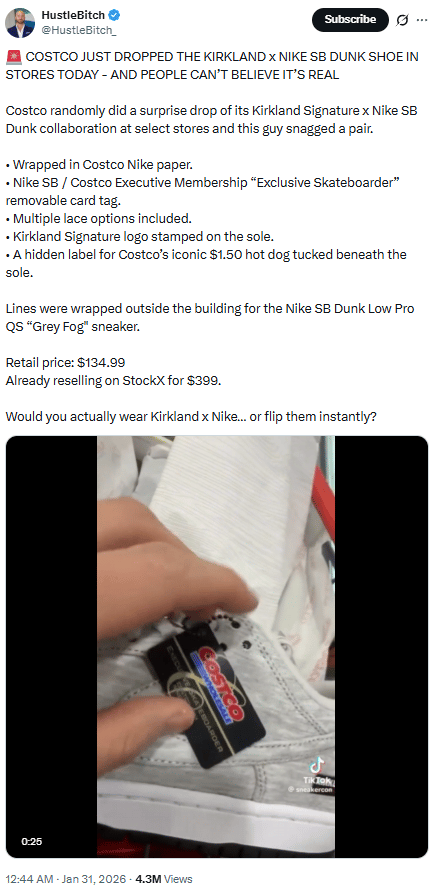
Costco had done a surprise drop of the Kirkland Signature x Nike SB Dunk Low — a shoe wrapped in grey sweatshirt material, stamped with the Kirkland logo on the heel, and hiding a tribute to Costco's famous $1.50 hot dog underneath the insole.
There was no announcement.
No press release.
No countdown clock on a landing page.
The shoes just showed up at a handful of stores in New York, Oregon, California, and Washington, priced at $134.99.
Within 72 hours, over 660 pairs resold on StockX alone. A size seven went for $5,000. The average resale price sat around three to four times retail, with pairs moving for $400 to $1,000.
Lines wrapped around buildings. Sneaker blogs called it one of the best drops in recent memory. Sole Retriever ran a headline that would have been unthinkable 18 months ago: "The Nike SB Costco Release Restored Our Faith in Sneaker Drops."
A $135 shoe, sold at the same store where people buy 48-packs of toilet paper, generating genuine sneaker hysteria.
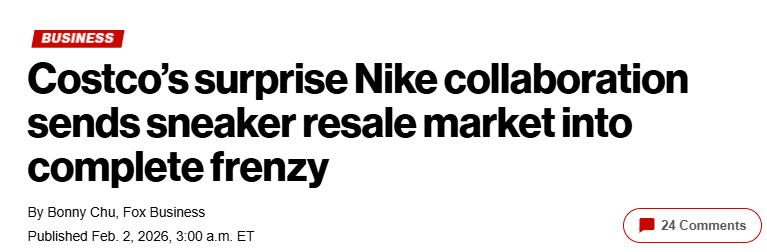
Something has changed.
America needs Nike to be cool.
Buckle up folks, it might just be happening…
To understand why a Costco sneaker drop matters, you need to understand how far Nike fell.
The numbers are brutal.
Nike's stock hit an all-time high of $177.51 in November 2021. As of early February 2026, it trades around $62. That's a 65% decline. The company has lost value four consecutive years: down 29.8% in 2022, 7.2% in 2023, 30.3% in 2024, and another 22% through 2025. Its market cap has cratered from $281 billion at its peak to roughly $92 billion.
On June 28, 2024, Nike had the worst single trading day in its history — shares dropped 21% after management disclosed that revenue would decline 10% the following quarter.
For fiscal year 2025 (ending May 2025), total revenue came in at $46.3 billion, down 10% from the prior year. Net income fell 44% to $3.22 billion. In North America, Nike saw sales decline. In Europe, sales declined. In China, sales declined. In Asia Pacific, sales declined.
Every single geography. Red across the board.
What happened?
The short answer is a CEO named John Donahoe and a strategy that traded cultural relevance for algorithmic efficiency.
Donahoe came from eBay. He believed Nike's future was digital-first, direct-to-consumer. The idea wasn't crazy — during COVID, when supply got constrained and demand surged, Nike's website and apps printed money. So Donahoe leaned in. Hard.
He pulled product from wholesale partners like Foot Locker and Dick's Sporting Goods. He prioritized Nike's own stores and digital channels. He cut back on the kind of athlete-driven storytelling that had made Nike culturally untouchable for decades. And he flooded the market with three legacy silhouettes — the Air Force 1, the Dunk, and the Air Jordan 1 — milking margin from proven designs instead of investing in newness.
The sneaker community noticed.
Nike stopped feeling special.
When Foot Locker once ran a 75% Nike operation, and then Nike pulled away, the retailer scrambled to fill shelf space with other brands. Adidas. New Balance. On Running. Hoka.
Suddenly those brands had oxygen they'd never had before. And consumers, bored of seeing the same three shoes in the same twelve colorways every month, followed them out the door.
While Nike's revenue was declining 10%, Adidas' sales were surging by double digits. Adidas CEO Bjorn Gulden — a former professional footballer who had previously led Puma — took over in January 2023 and engineered one of the most remarkable turnarounds in recent retail history. Adidas' stock price more than doubled from the depths of its Yeezy crisis. The Samba was named Shoe of the Year. At the 2024 FN Achievement Awards, Gulden accepted Person of the Year and couldn't resist a jab at his rival: "As I said last year when Nike was here — they're not here this year, which is funny."
Meanwhile, On Running and Hoka had captured nearly 20% of the premium running market — a category Nike once owned.
Nike hadn't just lost market share. It had lost the plot.
Then came Elliott Hill.
In October 2024, Nike's board brought back a lifer. Hill had spent 32 years at the company before retiring. He knew the product. He knew the culture. And he knew exactly what had gone wrong.
His diagnosis was blunt: Nike had drifted away from sport, away from athletes, away from the wholesale partners who put shoes in front of consumers, and away from the product innovation that had built the brand. His strategy, branded "Win Now," was essentially a promise to undo everything Donahoe had done.
Hill moved Nike's internal structure back to sport-specific categories instead of gender-based ones. He began rebuilding relationships with wholesale partners — rejoining Amazon, re-engaging Foot Locker and Dick's Sporting Goods. He launched an aggressive leadership restructuring, eliminating two C-suite roles and consolidating decision-making. He cut costs, too: 1,600 corporate jobs in 2024, another 775 distribution center roles in January 2026 as the company accelerated automation.
At the same time, Hill green-lit big cultural bets. NikeSkims — a full standalone brand created in partnership with Kim Kardashian's Skims — launched in September 2025. It wasn't a one-off collaboration. It was 58 silhouettes across seven collections, priced from $38 to $148, fronted by Serena Williams, Sha'Carri Richardson, Jordan Chiles, and Chloe Kim. Travis Scott started hosting underground street soccer events in U.S. cities as a preview of Nike's World Cup marketing push. The Nike A'One launched as the brand's first signature WNBA shoe. And the Kirkland Dunk proved Nike SB could still make the internet lose its mind.
The question investors keep asking: is any of this actually working?
That’s where it gets interesting and where LikeFolio has critical insight:
Members Only Beyond This Point
Become a paying member of LikeFolio Infinite Investor to get access to the rest this post and tons of other members-only content.
Already a paying subscriber? Sign In.
Premium Membership gets you:
- • ♾️ Infinite Hold List & Updates
- • 📃 Core Conviction List & Updates
- • 🫧 "On The Bubble" Alerts
- • 📺 Exclusive Videos & Webinars with the Swans
- • 📝 Key Notes from the Research Desk