LikeFolio Weekly Roundup: HIMS Roars Back
Plus: Nuclear fuel meets AI, Bitcoin flexes its strength, and more...

Andy Swan
March 13, 2026
This week delivered a powerful reminder of how quickly market narratives can change.
From Hims & Hers roaring back after a brutal selloff… to nuclear fuel colliding with AI… to Bitcoin breaking its usual macro playbook, several key themes are starting to shift.
Here’s what our Data Engine – and the headlines – are telling us now…
Hims & Hers Health (HIMS): +50% – The Narrative Is Flipping
After a brutal selloff, Hims & Hers Health (HIMS) surged 50% this week on a new Novo Nordisk (NVO) partnership.
The move marks a turning point – and the next chapter of the story is already taking shape.
For months, the stock traded as if the entire business hinged on one issue: GLP-1 weight-loss drugs.
When legal pressure forced HIMS to stop selling compounded versions last month, Wall Street assumed the growth engine had stalled. Investors rushed for the exits. The stock was cut in half.
Now the narrative is flipping.
Earlier this week, HIMS confirmed a new collaboration with Novo Nordisk – the company behind Ozempic and Wegovy – that will bring FDA-approved GLP-1 treatments directly onto the HIMS platform. Novo Nordisk also agreed to dismiss its lawsuit against the company, removing the biggest cloud hanging over the stock.
At the same time, HIMS introduced Hims & Hers Benefits, a new program designed to expand what a subscription actually delivers.
Subscribers can now access discounts on advanced health technologies, including Prenuvo whole-body MRI scans and Eight Sleep’s adaptive recovery beds. HIMS passes the savings directly to subscribers.
The strategy is clear: increase the value of the membership and deepen engagement across the platform.
That platform has already grown to 2.5 million subscribers. Over the past year, HIMS expanded into high-growth specialties including menopause care and hormone therapy while building a personalized care model that encourages patients to add services over time.
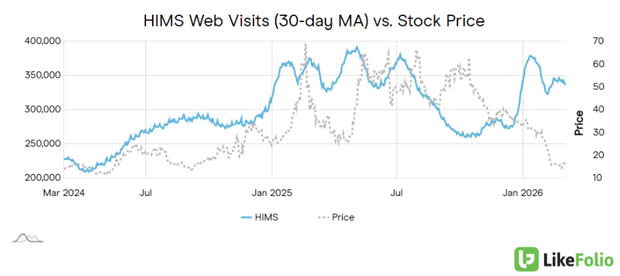
Our consumer data shows the momentum continuing. HIMS website visits are holding strong even as the stock plunged, signaling that consumer interest never cracked during the selloff:
We’re also tracking strong momentum on the Hers side of the business.
ForHers digital demand is up 13% year over year, extending a trend that pushed Hers revenue to more than double during 2025:
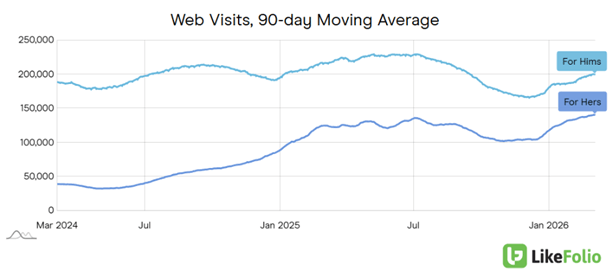
At this pace, the brand is approaching billion-dollar scale on its own.
That’s the kind of traction our Data Engine is built to identify early.
And judging by the emails we received this week, several LikeFolio followers recognized the opportunity during the panic.
Tom P. told us he entered HIMS at $18 per share after following our thesis. He’s now sitting on roughly 30% gains.
Dominick F. went even further. After watching his original position fall sharply, he doubled down at $16.29 during the selloff. With the rebound underway, he’s already closed most of the gap.
Our entry was $37, so the stock still has work to do. But perspective matters.
HIMS traded above $70 within the past year. And the platform behind the company continues to expand.
Bottom line: The market punished HIMS as if its biggest growth category disappeared. This week’s developments show the opposite. HIMS now has direct access to the most important weight-loss drugs in the world through the company that manufactures them – and it continues to expand the platform that keeps patients inside its ecosystem.
The long-term story never broke. Wall Street simply lost sight of it.
Centrus Energy (LEU): +13% – Nuclear Fuel Meets AI
LEU shares jumped about 13% this week after announcing a major new partnership with Palantir (PLTR). The goal: use Palantir’s AI software to run the company’s massive uranium enrichment expansion more efficiently.
Remember, Centrus isn’t producing ordinary nuclear fuel.
The company is leading America’s effort to manufacture HALEU – high-assay low-enriched uranium, the specialized fuel required for many next-generation nuclear reactors now under development.
That includes small modular reactors (SMRs) being backed by utilities, tech companies, and the U.S. government as a new source of reliable carbon-free power.
Right now, the U.S. has almost no domestic HALEU production. Russia has historically dominated the supply. Centrus is trying to change that – it's the only U.S. company producing this unique fuel cell at scale.
Palantir’s software will plug directly into Centrus’ operations – connecting data across the plant so managers can spot bottlenecks, predict equipment issues, and make faster production decisions.
Meanwhile, LikeFolio data shows LEU web visits – our best real-time read on forward-looking demand – gaining 32% year over year:

Attention is rising just as the HALEU opportunity begins to scale. That's where execution starts to matter.
Producing HALEU at scale is complicated and capital-intensive. Even small efficiency gains can dramatically improve project economics.
As advanced reactors move from blueprint to reality, someone has to supply the fuel.
Centrus is positioning itself to be that supplier. And this partnership gives it another tool to get there faster.
Infinite Hold Updates
Bitcoin (BTC) Defies the Usual Playbook
Bitcoin just did something unusual.
A stronger U.S. dollar (USD) usually pull liquidity away from speculative assets like crypto and tech stocks. But Bitcoin ignored the script this week.
As the Dollar Index (DXY) pushed above 100, Bitcoin climbed past $72,000 and briefly approached $74,000. Stocks struggled to keep up.
Now the next key Bitcoin level sits just ahead: A high-volume break above $74,000 could open the door to a run toward $80,000.
Bitcoin is showing relative strength even when macro conditions say it shouldn’t.
When that happens, the ripple usually spreads quickly – across Bitcoin miners, exchanges, and crypto-linked equities.
And we’re already starting to see that ripple form.
Tesla (TSLA) Reclaims Ground in China’s EV Battle
Tesla just showed it’s still a force in the world’s toughest EV market.
Tesla’s China-made vehicle sales jumped more than 35% in January and February, climbing to 127,728 units from 93,926 a year ago.
That’s a strong rebound – especially since the numbers were adjusted for the usual slowdown around the Chinese New Year holiday.
At the same time, BYD’s deliveries fell 36% from a year ago over the same stretch. After losing the global EV crown to BYD in 2025, Tesla needed a sign that demand was still alive. This was one.
China is the biggest EV battlefield on Earth – selling about 8x more EVs than the U.S. And Tesla is still in the fight.
If it can hold its ground here, it proves Tesla’s brand and technology can compete against the most aggressive EV rivals in the world.
LikeFolio followers know TSLA is much more than a car company. But every car Tesla sells expands the real prize: its global AI and robotics platform.
Amazon (AMZN) Pushes Deeper into Digital Healthcare
Amazon just made another subtle move into one of the largest markets in the world: healthcare.
This week, the company expanded Amazon Pharmacy’s access to Eli Lilly’s (LLY) blockbuster weight-loss drug Zepbound, including the new KwikPen device – with transparent pricing starting at $299 per month and fast home delivery.
As we’ve seen with HIMS, GLP-1 drugs like Zepbound are quickly becoming one of the biggest pharmaceutical markets on Earth. Analysts expect the category to generate more than $100 billion annually within the next decade. Amazon is positioning itself directly in the middle of that wave.
Here’s where its advantage comes in: Unlike traditional pharmacies, Amazon can combine online ordering, price transparency, telehealth visits through One Medical, and same-day delivery to more than half of U.S. households into a single ecosystem.
In other words, this isn’t just about selling prescriptions.
It’s about turning healthcare into another high-frequency service that runs through the Amazon platform.
The more essential services Amazon embeds into everyday life, the harder it becomes for consumers to leave the ecosystem.
That’s exactly the kind of long-term moat we want to own.
Google (GOOGL) Doubles Down on Cloud Security
Google just made a strategic move in one of the most important battlegrounds of the AI economy: cloud security.
This week, the company completed its acquisition of Wiz – one of the fastest-growing cloud security platforms in the world. Wiz builds software that scans a company’s entire cloud system, spots vulnerabilities, and flags them before hackers can exploit them. In plain English: it helps companies find security holes in their cloud infrastructure before they turn into breaches.
That matters more than ever as AI workloads explode. The more data and models companies move into the cloud, the bigger the attack surface becomes.
By folding Wiz into Google Cloud, Google strengthens the trust layer around its infrastructure. Enterprises want powerful AI tools – but they also need ironclad security protecting their data and models. This deal helps Google deliver both.
Bottom line: As the AI buildout accelerates, security becomes mission-critical infrastructure. This move positions Google to capture more of that spending while making its cloud platform harder for enterprises to leave.