LikeFolio Weekly Roundup: Where Power Is Building Now
This week, the market is revealing where the real power is building.

Andy Swan
April 10, 2026
This week, the market isn’t just moving – it’s revealing where the real power is building.
We’re seeing the same pattern across very different names: scale advantages turning into dominance.
Amazon (AMZN) is stacking three engines that feed each other. Tesla (TSLA) is accelerating its data flywheel. Google (GOOGL) is owning the AI ecosystem from the inside out.
And then you’ve got names like Oscar Health (OSCR) – where the fundamentals haven’t fully hit yet, but the demand already has.
This is where we win.
Not chasing headlines... but spotting the platforms getting stronger, faster, and harder to compete with — before the financials force everyone else to pay attention.
Let’s break down the moves.
Amazon (AMZN): Three Engines, One Surge
Amazon is up nearly 10% higher over the last few days alone after CEO Andy Jassy reminded investors how this company really wins: not in straight lines, but in compound loops.
Jassy’s shareholder letter captured Wall Street’s attention. Here’s what matters for us:
Amazon’s AWS is already running at a $15 billion-plus AI revenue pace – and demand is outstripping supply. That matches what we’ve been seeing in the data: enterprise cloud spending continues accelerating as companies rush to build AI capabilities.
Now layer in the cost advantage. Amazon’s custom chips (Trainium, Graviton) are delivering up to 30–40% better price-performance – expanding margins while competitors are stuck renting capacity from Nvidia.
Then look at the physical network. Over 1 million robots now power fulfillment centers, driving faster delivery and lower costs. Same-day is scaling. Rural is expanding. And every efficiency gain compounds.
Amazon isn’t one business. It’s a three-engine machine – retail, AWS, and a high-margin advertising layer most investors still underestimate.
Tesla (TSLA): A Cheaper SUV Changes the Math
Reports surfaced this week that Tesla may be developing a smaller, lower-cost SUV – potentially opening itself up to a future $22.7 billion electric truck and SUV market.
The company hasn’t confirmed it. And it’s still early. But the report points to a vehicle that’s shorter, lighter, and built for a much lower price point than anything Tesla currently offers.
A lower-cost SUV would expand Tesla’s reach and put more cars on the road, faster. Every one of those vehicles feeds the same system – real-world driving data that trains Full Self-Driving.
More cars → more data → better AI → stronger network.
This isn’t about filling a gap in the lineup. It’s about accelerating the entire platform.
And the faster that flywheel spins, the harder it becomes for anyone else to catch up.
Google (GOOGL): Owning the AI Ecosystem
Tesla is scaling AI through more vehicles on the road.
Google is doing it with capital.
This week, CEO Sundar Pichai made it clear: the AI boom is creating more chances to put billions to work – and Alphabet is leaning in. The results already show across a web of strategic investments.
But this goes deeper than smart investing.
These aren’t just bets. They plug directly into Google’s core business. Anthropic runs on Google’s cloud, using its custom-built AI chips called TPUs – locking in cloud revenue for years.
So the loop kicks in:
Money goes out → demand comes back → the platform scales.
That’s a different kind of AI advantage.
Tesla feeds its model with real-world data. Google feeds its with capital and control across the entire ecosystem.
And when you own the pipes and the players... you don’t just participate in the upside.
You collect it.
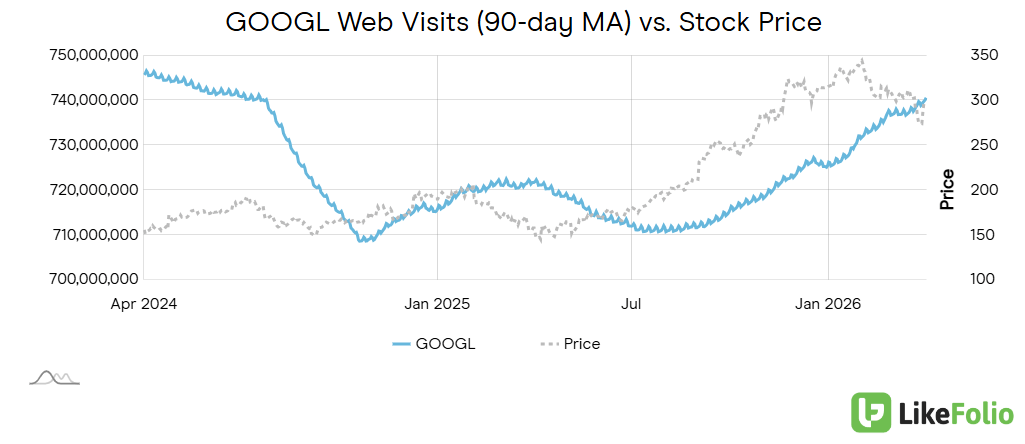
GOOGL digital demand is holding strong – and the upside is just getting started.
Portfolio Spotlight: Oscar’s (OSCR) Big Bet on 2026
OSCR jumped 14% this week as the market catches onto the bullish thesis we flagged in May of last year.
Oscar sells health insurance directly to consumers – but unlike traditional insurers, it runs everything through a single tech platform, using AI to handle claims, care navigation, and member engagement at scale.
CEO Mark Bertolini is sticking to one message: 2026 is the year Oscar turns profitable. And the path is clear.
OSCR’s consumer-driven platform is gaining share, using technology to remove friction, and positioning for margin expansion as it scales:
Its "Oswell" AI health agent now handles 86% of member questions. Response times dropped 67% during peak demand.
It pushed through a 28% rate increase for 2026 – resetting its risk pool as subsidies roll off.
Membership hit a record 3.4 million, and market share climbed to 30%.
Management is guiding for a ~$750 million swing in operating earnings this year.
And then Bertolini backed it up with his own money.
He stepped in and bought more than 1 million OSCR shares on the open market – a clear signal he believes the market is still underestimating what this company is becoming.
That’s the kind of alignment we look for.
And according to our forward-looking demand metrics, users are showing up ahead of the profits. OSCR web visits are up 74% year over year:
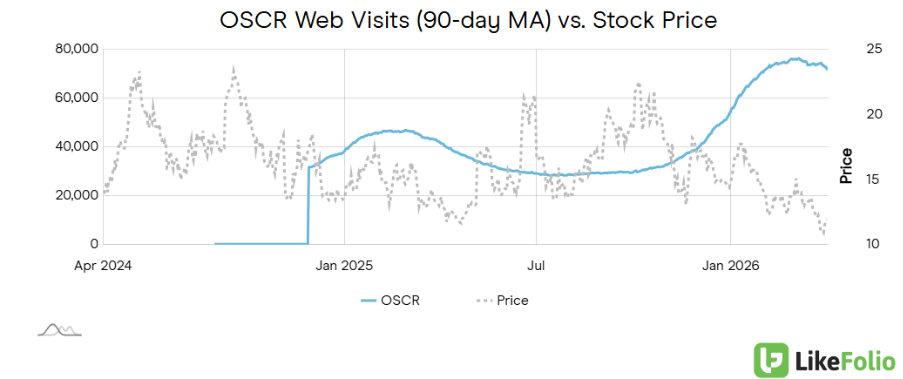
The platform is scaling. The model is tightening. And the path to profitability is finally coming into focus.
This is how LikeFolio members win – getting positioned before the financials flip and the rest of the market is forced to catch up.