LikeFolio Weekly Roundup
From Peptides to Satellites, Our Playbook Is Working

Megan Brantley
April 17, 2026

Different headlines. Same playbook.
Whether it’s Hims & Hers (HIMS) tapping into the next wave of healthcare demand…
Tesla (TSLA) building the AI brain behind autonomy…
Amazon (AMZN) moving to control global connectivity…
Or Bitcoin (BTC) confirming its next leg higher…
The winners right now are tightening their grip on the systems everything else depends on.
Here’s a look at the massive moves we’re tracking this week.
Infinite Hold Updates
Tesla (TSLA): The Chip That Changes Everything
Elon Musk just revealed its next-gen AI5 chip – the brain that will power everything from Full Self-Driving (FSD) to Optimus.
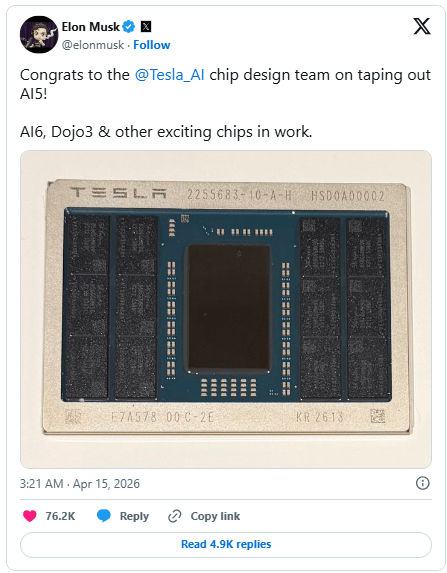
AI5 delivers roughly 5x the compute of the current AI4 system. In plain terms: Tesla’s cars and robots will be able to process far more data, make faster decisions, and run much larger AI models – all on-device.
That matters more than any single vehicle launch. Because this is the engine behind the entire platform.
More powerful chips → bigger models → better autonomy → more real-world usage → more data coming back in.
Tesla isn’t buying this technology. It’s building it.
And that vertical integration – hardware + software, designed together – is what allows Tesla to move faster, cut costs, and pull further ahead.
AI5 doesn’t hit full production until 2027.
But the signal is clear today: Tesla is scaling the one advantage that compounds over time – and it’s getting stronger.
Tesla’s Consumer Score remains firmly in bullish territory as interest clusters around autonomy, AI, and robotics.
Earnings are due next Wednesday, April 22. This is the setup you need to know before the numbers hit.
Bitcoin (BTC) Pushes Past $76K – Right on Schedule
Bitcoin just crossed $76,000.
That’s not a surprise. It’s the playbook we laid out weeks ago starting to unfold in real time.
Go back to February. Gold was already running. Bitcoin was down 47% from all-time highs. And historically, that gap doesn’t last – it snaps back fast.
We called that “crash” what it really was – a setup. Leverage flushed out. Retail panic selling. Meanwhile, institutions and governments were quietly stepping in and accumulating.
Then in March, we called the exact turn – when fear peaked, shorts crowded in, and Bitcoin started ripping.
Now you’re seeing the next leg.
BTC cleared $74,400. Flows returned. Retail interest picked up. And now the price is holding higher.
This setup is playing out right on schedule.
Bitcoin is emerging as a global store of value in a world drowning in debt, conflict, and currency pressure.
Buyers stepped in on fear. Engagement stayed strong through negative headlines.
We were early on this turn.
Now it’s no longer a call. It’s confirmation.
Amazon (AMZN) Buys the Signal – And Expands the Network Again
Amazon is buying its way into the sky.
The company just announced a $11.6 billion acquisition of Globalstar (GSAT) – a satellite operator with something incredibly valuable: licensed spectrum and direct-to-device connectivity.
This builds directly on Amazon’s recent Delta (DAL) partnership, which brings its LEO satellite network onto 500 aircraft.
Now it’s moving upstream – owning the infrastructure behind that network.
Globalstar gives Amazon a shortcut most competitors don’t have: pre-approved global spectrum.
Amazon can connect phones, planes, packages – almost anything – without waiting years for regulatory approval.
That means controlling the signal linking devices to the internet – from a phone in your hand… to a plane at 30,000 feet… to a package moving through its network.
Once Amazon controls that layer, everything else plugs in.
Shopping. Ads. Streaming. Data.
But there’s another layer here to consider...
Satellite connectivity is becoming core infrastructure for AI. These systems need constant, global data flow – not just in cities, but everywhere.
That puts Amazon in position to power – and profit from – that constant stream of data.
Bottom line: Amazon isn’t just chasing Starlink.
It’s building the backbone for its entire ecosystem.
Retail drives traffic. AWS powers compute. Ads capture margin. Satellites expand the reach again.
Google (GOOGL): The “Bad News” That Tightens Its Grip
This week, regulators in Brussels proposed forcing Google to share its search data – including data tied to AI-powered search tools – with competing platforms under the Digital Markets Act. A final decision is expected in July.
That sounds like a direct hit.
But look closer – this is what pressure on dominance looks like.
Google isn’t being targeted because it’s losing ground. It’s being targeted because it still controls how billions of people search, ask questions, and make decisions online.
And that behavior is only getting stronger as AI layers on top.
Google is no longer just a search engine. It’s becoming the decision engine behind AI-driven actions – what LikeFolio flagged early as the rise of “agentic commerce,” where AI doesn’t just suggest… it executes.
Every query. Every click. Every transaction.
That data loop is the moat. And regulators trying to crack it open only confirms how valuable it’s become.
The narrative says regulation is a risk.
The data says Google is becoming the default layer for how people think, search, and buy.
Portfolio Spotlight – Peptides, Nuclear Fuel, Short Squeeze Noise
Hims & Hers Health (HIMS): +39%
HIMS ripped 39% in the last six days to become the biggest mover of the week.
The trigger: the FDA just scheduled July advisory meetings to review seven peptides – a key step toward defining how these treatments can be offered more broadly.
That opens the door for HIMS to tap into one of the fastest-growing categories in modern healthcare.
The U.S. peptide therapeutics market already hit $65 billion in 2024. It’s expected to more than double to $160 billion by 2030, growing at nearly 15% per year. And the biggest driver? Metabolic health – the same category that turned GLP-1 drugs into a global phenomenon.
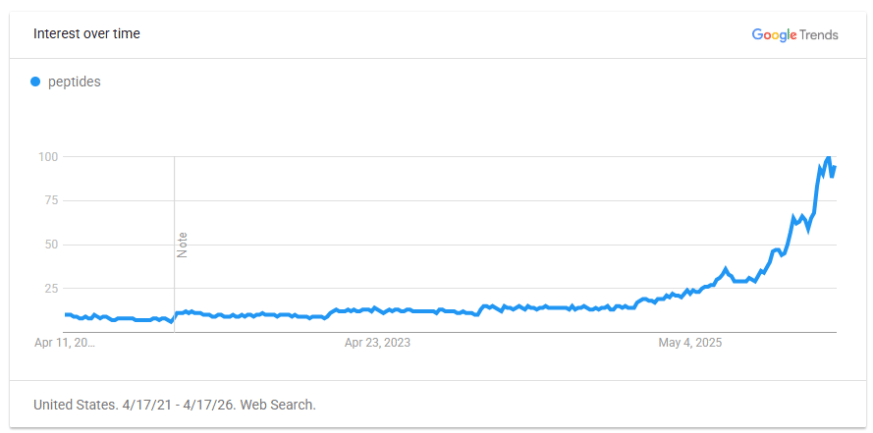
Consumer interest in peptides has exploded over the last five years – and HIMS prepared for this moment.
Last year, it acquired a California-based peptide facility – quietly building supply chain control in a category most competitors still have to outsource.
If the FDA provides a clear framework, HIMS is ready to move. Fast.
That means taking a category with surging demand… and plugging it directly into a built-in audience of millions who already trust the platform with their care.
Our data kept us ahead of this opportunity. While the stock was getting cut in half earlier this year, we saw demand holding strong – and steadily built our position.
This is how these turnarounds start – first the data, then the narrative, then the stock.
Oklo (OKLO): +28%
Nuclear stocks snapped back this week – and OKLO led the charge, jumping 28% as fresh capital flowed into the space.
The spark came from overseas. The U.K.’s National Wealth Fund just committed $805 million to back Rolls-Royce’s (RYCEY) – not the luxury car brand, but the engineering firm behind nuclear submarine reactors and military-grade propulsion systems.
The funding will support its rollout of small modular reactors (SMRs) – smaller, faster-to-build nuclear plants designed to deliver power closer to where it’s needed.
The world needs more power. Fast. Nuclear is stepping in to fill that gap. And real money is moving in as projects are moving from idea to deployment.
But while the sector rallied on headlines, Oklo kept executing behind the scenes.
The company just expanded its partnership with Sweden’s Blykalla – a nuclear startup developing compact reactors cooled by liquid metal, designed to run safely and efficiently for long periods.
The partnership brings $100–200 million in potential investment and 30–40 engineers into the U.S. to help speed up development.
That’s talent, capital, and speed – all pointed at commercialization.
We already locked in a 461% gain on half our OKLO position last September. The rest is still up more than 300%.
And the story hasn’t slowed down.
SoundHound (SOUN): +20%
SOUN burst nearly 20% higher this week, but this wasn't the typical rally. Earnings don’t release until next month. No big acquisitions hit the wire.
Traders are pointing to a short squeeze. And yes – that can move a stock fast.
When investors bet against a stock, they have to buy it back later. If the price rises, they rush to cover. That buying pushes shares even higher. Then more shorts pile in. It feeds on itself.
With roughly 32% of SOUN shares sold short, it doesn’t take much to spark that chain reaction.
But the short squeeze is just noise. What matters is real-world adoption.
Voice AI is starting to power actual customer interactions – and SoundHound is right at the center of it.
Last quarter, revenue grew 59% to $55 million. Full-year revenue nearly doubled to $168.9 million. Losses came in far smaller than expected.
Now the company is pushing deeper into telecom.
SoundHound just partnered with Associated Carrier Group to bring its AI platform to smaller mobile operators. These companies deal with constant call volume, long wait times, and high support costs. SoundHound’s system steps in to handle full conversations – not just answer questions, but resolve issues from start to finish.
Companies can handle more requests with less staff. Customers get answers without waiting on hold. And the cost to serve each interaction starts to drop.
We’re seeing the same pattern across industries. Auto insurers handling 150% more calls with AI. Restaurants rolling out voice ordering at scale. Exactly what we expected when we made our bullish call in March 2024.
The next big checkpoint comes when SoundHound reports earnings in May. The financials will tell us if the company can turn that demand into consistent execution.
For now, remember that short squeezes can drive sharp moves in the near term. But over time, SOUN wins if its AI keeps taking over more of these real-world interactions.
DoorDash (DASH): +17%
A grandmother just delivered DoorDash to the White House – and the stock soared 17%.
The internet ran with “DoorDash Grandma.” The clip went everywhere. It made for a great headline.
But the real story is what’s happening under the hood.
DoorDash just expanded its drone delivery partnership with Wing into the metro Atlanta area – with orders arriving in as little as 20 minutes. This builds on a network already live across multiple U.S. markets, with tens of thousands of deliveries completed.
Most investors are still missing the bigger picture: DoorDash is building the operating system for local commerce. A system that blends Dashers, drones, and autonomous vehicles into one network – all optimized by AI.
Now look at what DoorDash is seeing across millions of real transactions:
Breakfast prices down 22% year over year.
Restaurant price growth steadying to 3.2% year over year.
Everyday essential costs down 0.3% year over year.
Americans are getting relief in real time. When those costs ease, order frequency tends to pick up.
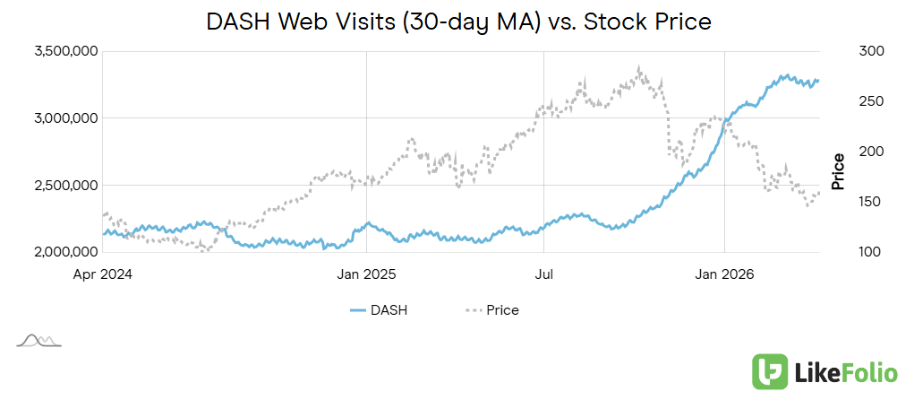
And our data supports it. DASH web visits are rocketing 57% year over year – accelerating a sustained uptrend that began well before the White House moment ever hit social media.
Consumers want faster, easier, more reliable delivery. DoorDash keeps removing friction at every step. And the more seamless it gets, the more this platform becomes part of everyday life.
The behavior showed up first. The stock is starting to follow.
And if this network keeps scaling the way it is… this 17% move is the start of a much larger run.