LikeFolio Weekly Roundup: This Is What Real Momentum Looks Like
Tesla tightens control, Bitcoin breaks through, and the next wave starts to take shape...

Andy Swan
March 20, 2026
This week, we saw what real momentum looks like.
Tesla (TSLA) taking direct control over how factories come together – compressing timelines and removing one of its biggest bottlenecks.
Bitcoin (BTC) is pulling in fresh capital at a critical level.
Big Tech is getting more personal – and more powerful.
And Amazon (AMZN) is tightening control over the last mile.
These aren’t isolated moves. They’re signals.
Read this week’s roundup to see where the leverage is building… and how to position before the market catches up.
Infinite Hold Updates
Tesla’s (TSLA) Next Layer of Control

“Terafab Project launches in 7 days.”
– @ElonMusk, March 14, 2026
Six words. That’s all it took to get our attention.
Terafab is Tesla’s attempt to rebuild how factories get built. Instead of slow, on-site construction, Tesla is moving toward prefabricated factory systems – built in sections, shipped in, and assembled fast.
Think fewer delays. Lower costs. Faster ramp times.
This is how Tesla compresses the timeline between demand showing up and supply hitting the market.
Every new factory has been a bottleneck at some point – from Model 3 production hell to the slow ramps in Berlin and Austin. Terafab aims to remove that friction.
Musk has a proven track record of pulling critical pieces in-house. This is the next step.
It's an enormous moonshot. There's real risk. But if it works, it will put Tesla into another stratosphere of “class of its own.”
Bitcoin (BTC) Breaks the Level That Matters
Bitcoin cleared the critical zone we were waiting for – closing above $74,400 on Monday, right as short sellers got squeezed and fresh money poured in.
U.S.-listed spot Bitcoin ETFs have pulled in roughly $1.5 billion this month alone. That’s real capital stepping back into the trade.
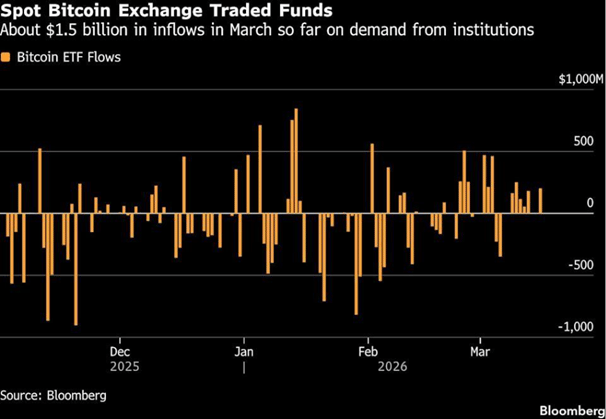
And it’s not just institutions. Retail is waking up.
Searches like “how to buy bitcoin safely” and “where to buy bitcoin” are climbing again – a signal we’ve seen before major altcoin runs.
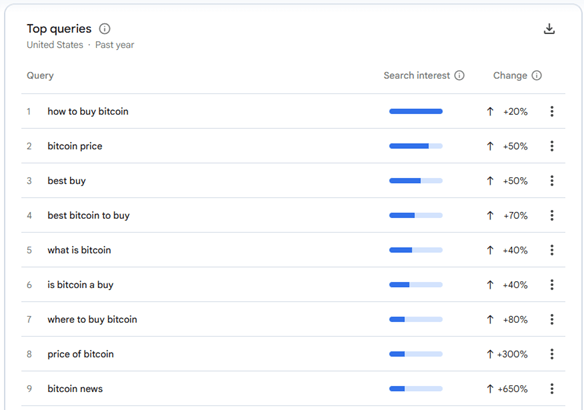
This is how momentum builds. It starts with Bitcoin. Then it spreads.
Now we watch closely. If this demand holds, the next leg higher can come fast.
Google (GOOGL) AI Gets Personal
Earlier this week, Google expanded its “Personal Intelligence” across Search, the Gemini app, and Chrome – turning its AI into something far more personal. Instead of generic results, Google now pulls from your own data – Gmail, Photos, past purchases – to deliver answers tailored to you.
Think about what that means in practice. Search no longer just finds links. It knows what you bought, where you’ve traveled, what you like – and builds answers around it. Shopping suggestions match your style. Travel plans pull from real bookings. Even tech support adapts to the exact device you own.
This is a shift from information retrieval to decision-making.
And it matters because Google already sits on billions of daily user interactions.
The more useful and personalized those interactions become, the longer users stay inside Google’s ecosystem – and the more valuable each search becomes.
Amazon (AMZN) Cuts Out the Middleman
Amazon is preparing to slash its use of the U.S. Postal Service by as much as two-thirds.
For years, USPS handled a sizable share of Amazon’s deliveries – over a billion packages a year. Now that pipeline is shrinking just as USPS faces a cash crunch and uncertainty around its future.
Amazon isn't worried. It's pouring more than $4 billion into its own rural delivery network. More trucks. More routes. More control over how and when packages show up at your door.
This is how Amazon tightens its grip.
Owning the delivery network means faster shipping and lower costs over time. It also leads to a better customer experience and puts Amazon in a stronger position every time it sits down to negotiate with partners.
Every mile Amazon takes in-house is one less dependency – and one more advantage.
Portfolio Spotlight: LMND, OKLO, BROS
Lemonade’s (LMND) Edge Is Starting to Show
Wall Street is finally waking up to LMND’s potential.
Back in January, Lemonade partnered with Tesla to price policies off real driving data – cutting premiums by up to 50% when Full Self-Driving (FSD) is active. Effectively rewriting how insurance works.
This week, LMND rallied more than 15% as Morgan Stanley upgraded the stock and raised its price target to $85, pointing directly to that Tesla partnership as a long-term growth driver.
That’s the Street catching up to a shift already in motion.
The new AI-powered insurance model improves with scale. Every mile driven feeds new data into Lemonade’s system. Every software update from Tesla sharpens how risk gets priced.
Over time, that drives lower claims costs and better margins – while legacy insurers keep relying on static averages that don’t adjust in real time.
Morgan Stanley made another key point we already knew: Even with lower premiums, underwriting discipline holds. Pricing still reflects actual risk.
That rare combination leads to:
Lower prices for customers
Better data for the insurer
Stronger economics over time
While the rest of the market focused on short-term noise, we saw Lemonade positioning itself inside a new category tied directly to autonomous driving.
Now that positioning is starting to show up in Wall Street models – and you’re reaping the benefits.
We still have the edge here: The latest LikeFolio data shows LMND web visits gaining +49% year over year – a strong measure of future demand:
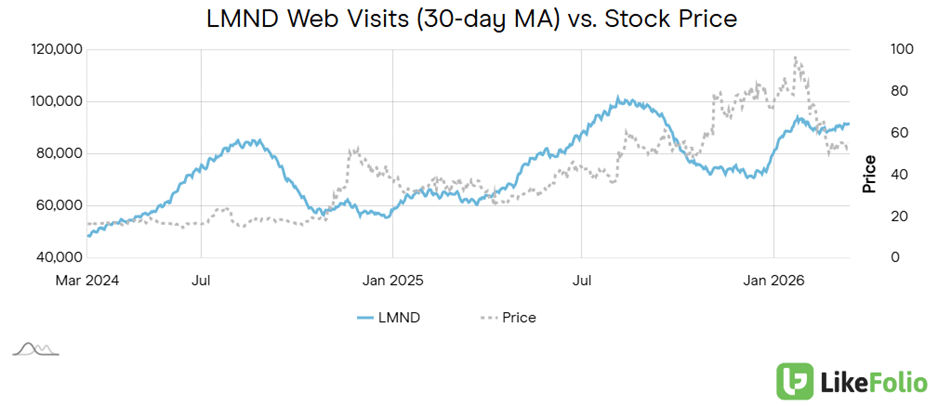
Autonomous driving is scaling. Insurance is being rebuilt around it. Lemonade already has the data advantage. And models like this don’t stay mispriced for long.
Oklo’s (OKLO) Buildout Phase Begins
Oklo just crossed a line most early-stage nuclear companies never reach: Regulators gave it the green light to move from plans to physical projects so the real buildout can begin.
The Department of Energy approved safety frameworks for its first reactor and isotope facility
The Nuclear Regulatory Commission gave Oklo its first license to handle nuclear materials
Both projects now move into the next phase of construction and review
These approvals allow Oklo to go from drawings on paper to steel in the ground.
Oklo’s Idaho lab is now licensed to process radioactive materials – and expects to generate initial revenue this year. The company can take nuclear material, refine it, and sell it as isotopes – rare elements used in cancer treatments, medical imaging, and industrial tools.
We also learned Oklo’s first isotope reactor in Texas is on track for a July 2026 breakthrough.
Meanwhile, at Idaho National Lab, Oklo’s first Aurora reactor is already moving:
Construction has started
Key equipment is locked in
The government has signed off on the safety approach
The 75-megawatt (MW) plant is designed to deliver constant power with no weather risk and no downtime.
That matters more than ever as demand for always-on AI power surges – and very few energy sources can deliver it.
Oklo is already stepping into that gap with a 1.2 gigawatt power campus tied to Meta Platforms (META).
But nuclear reactors don’t run without fuel. And right now, fuel supply is tight.
Oklo calls this one of the biggest constraints on the industry.
That’s where Centrus Energy (LEU) is stepping in with a plan to build fuel processing at the same site as future reactors.
Centrus enriches uranium – basically, it prepares the fuel
Oklo uses that fuel to power its reactors
Working together cuts costs and speeds things up. Plus, it removes a key bottleneck. Good news all around.
We spotted the nuclear trend early. We placed our bets. Now, we’re seeing both sides of this trade line up at once.
Dutch Bros’ (BROS) Brand Is Getting Bigger Than the Drive-Thru
Dutch Bros just put up the kind of quarter we want to see from a young growth brand still in expansion mode.
Fourth-quarter revenue jumped 29% to $443.6 million, while same-shop sales climbed 7.7% and transactions rose 5.4%.
That last number matters most. It means more customers are showing up – not just paying higher prices.
BROS proved it can scale profitably: Net income more than quadrupled to $29.2 million, while adjusted EBITDA surged 49% to $72.6 million. That gives Dutch Bros real operating leverage as it opens new stores and pushes into new markets.
Meanwhile, the store engine keeps expanding – and it’s early innings. Dutch Bros opened 154 new locations in 2025, plans to open at least 181 more in 2026, and still aims to reach 2,029 shops by 2029.
The BROS playbook is working – more stores, more traffic, and now a brand that’s moving from drive-thru windows into grocery aisles across the country.
We want to own brands that customers turn into habits. Dutch Bros keeps proving it is one.